



Matted dog: What to do and how a dog groomer in Berlin can help
Is your dog matted? How to check for matting at home, what you can brush out yourself, and when de-matting or a short clip at a dog grooming salon in Berlin is necessary.
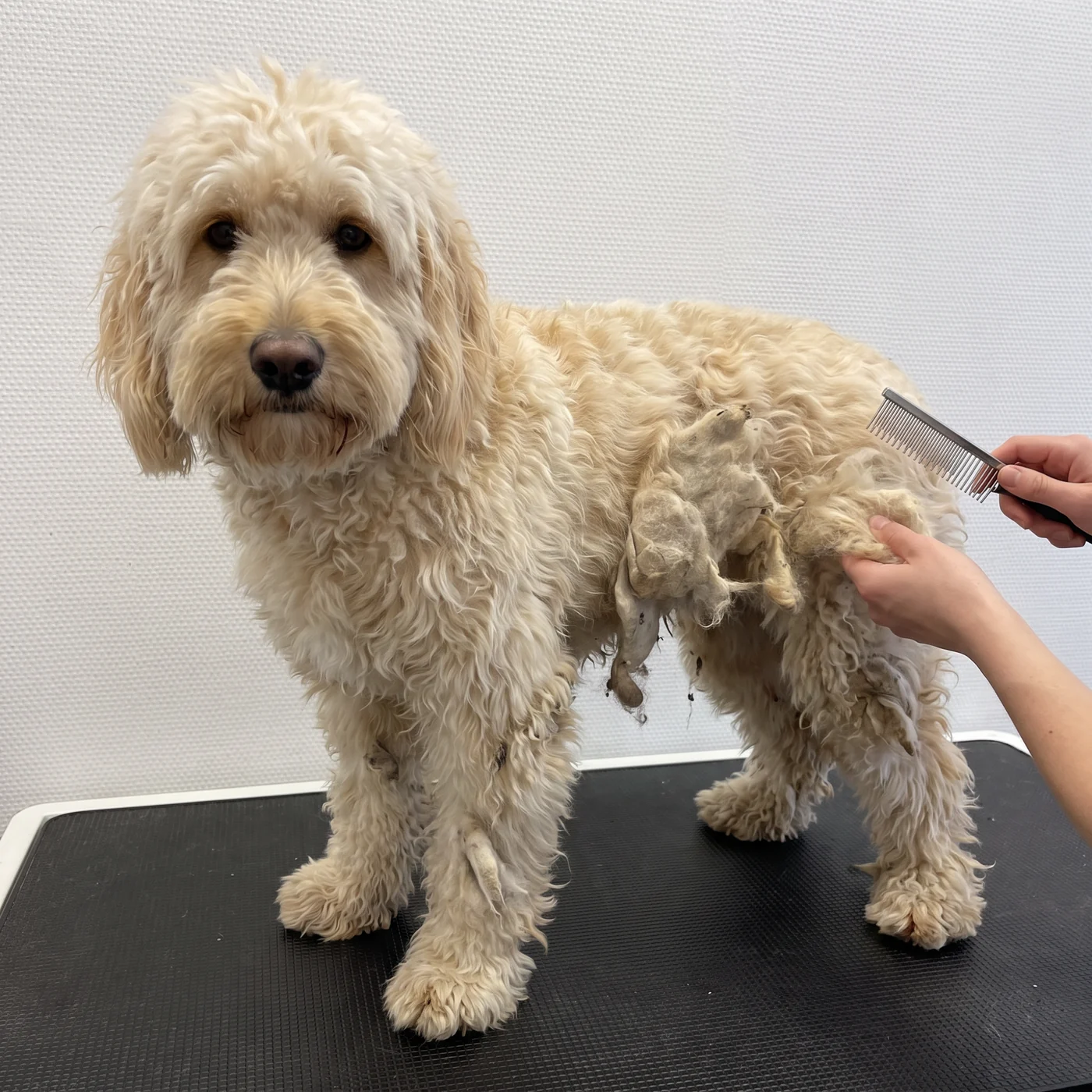
You can tease out minor knots at home using a metal comb and de-matting spray, working layer by layer from the tips to the skin. If the matting sits flat against the skin, only a salon can help. Here at GroomRoom in Berlin, we assess the coat, give you a price upfront, and offer de-matting from 15 € per 15 minutes started, or honestly advise a short clip.
- Quick test
- The comb must glide down to the skin without resistance
- De-matting
- from 15 € per 15 minutes started, in addition to the groom
- Price example
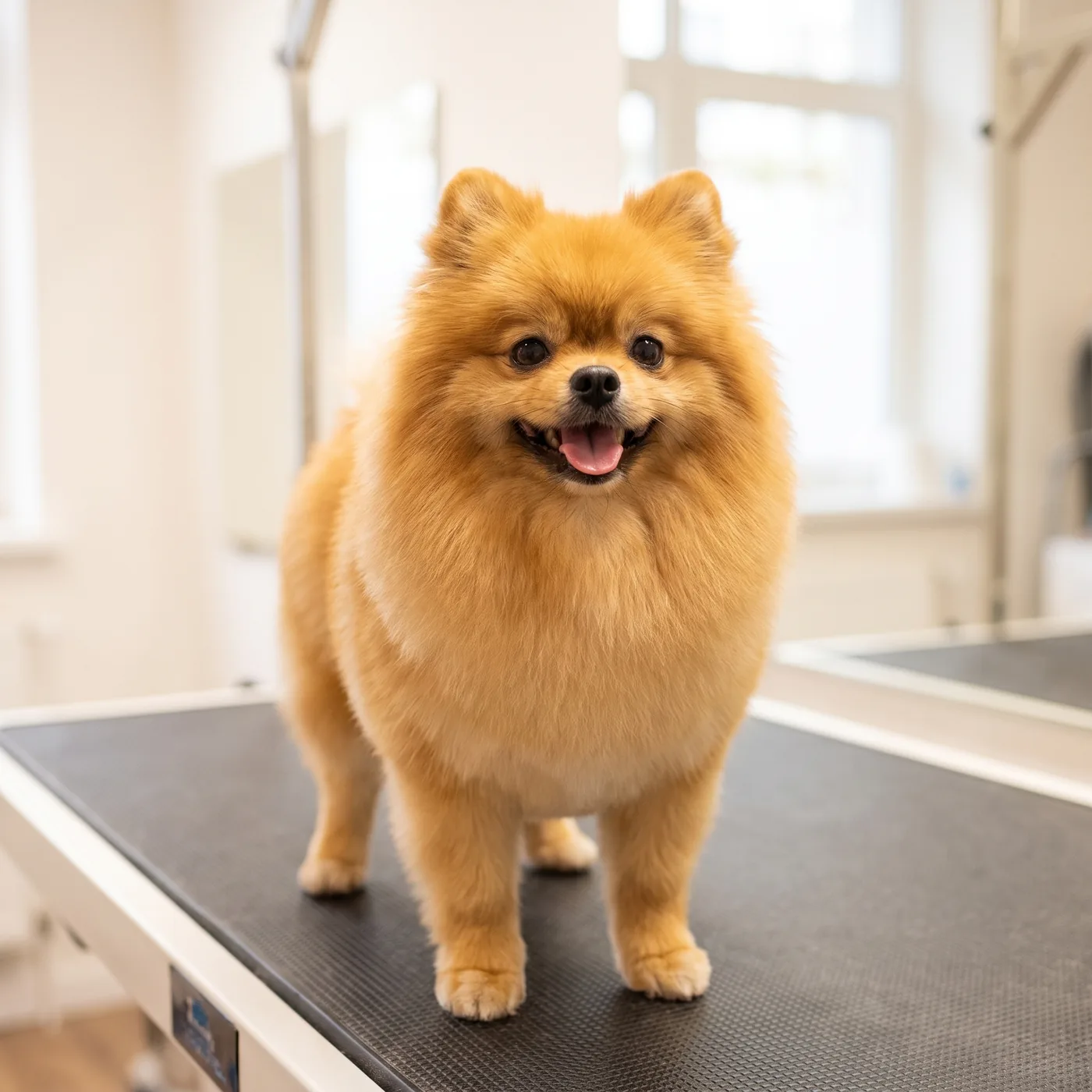
- Pomeranian after 6 months without a salon: 165 to 180 €
- Price
- binding quote before the appointment after a personal assessment
- Prevention
- Brushing down to the skin, salon every 6 to 10 weeks
If your dog is matted, the first step is a close look at how bad it is. You can tease out individual soft knots yourself with a metal comb and a de-matting spray. If the matting is flat and right against the skin, your dog needs to visit a salon. At our dog grooming salon GroomRoom in Berlin Charlottenburg, we assess the coat and give you the price upfront. We'll tell you honestly whether de-matting still makes sense or if a short clip would be better.
How matting forms and why it damages the skin
Matting forms from loose undercoat that isn't reached down to the skin during brushing. The undercoat is the soft, dense layer of hair beneath the topcoat that keeps your dog warm. During shedding season, this undercoat comes loose and gets caught in the longer topcoat. Friction from collars, harnesses, playing, and lying down twists the loose hairs into knots. Moisture from rain or bathing then pulls these knots together into solid mats.
Underneath a solid mat, air can no longer reach the skin, and moisture doesn't dry. The skin becomes sore, itchy, and inflamed, and the dog scratches at those areas. The matting also pulls on the skin with every movement, causing pain with every step. Skin irritations under the matting often go unnoticed for a long time because no one can see the skin. That's why we always treat a matted dog coat as a health issue.
The quick test at home: Does the comb glide down to the skin?
All you need for the test is a medium-toothed metal comb and five minutes. Place the comb on a spot and guide it vertically down to the skin. If it glides through without resistance, the coat is fine in that area. If it gets stuck or doesn't reach the skin, mats have already formed.
Pay special attention to the following areas, where mats typically form first on a dog:
- Behind the ears, because the hair is fine there and creates a lot of friction.
- In the armpits, because the harness rubs against the coat with every step.
- On the belly and around the genitals, because the coat often gets damp there.
- On the back of the hind legs and the tail, because the dog lies on them.
- Between the toes and on the paw pads, because dirt collects there.
Additionally, run your fingers against the grain over the back and flanks. If you feel hard lumps under the smooth topcoat, the undercoat has already clumped together.
Untangle minor knots yourself, but with patience
You can untangle small, soft knots at home as long as your dog stays relaxed. Spray the knot with a de-matting spray and let it soak in briefly. Then hold the hair with your fingers right above the skin so it doesn't pull. Work with the comb from the tips of the hair, layer by layer, towards the skin. Tease larger knots apart lengthwise into smaller strands with your fingers first. Take a break after a few minutes, praise your dog and continue later.
You can recognise a minor mat if the knot can still be moved with your fingers. When pulling it apart, you can still see individual hairs in between, rather than a solid pelt. Afterwards, comb through the area thoroughly again to check the result.
These three mistakes make matted coats worse
We see three mistakes time and again at GroomRoom, and all three are well-intentioned. The first mistake is using scissors directly against the skin. Matted fur sits tightly, and the skin gets pulled into the blade when cutting. Cuts on the armpits and belly happen in seconds this way, and the wound is then hidden under the remaining mats.
Never use scissors near the skin, not even for a single knot. Cut off the very tip at most and leave everything else to the comb or the salon.
The second mistake is bathing your dog before thoroughly brushing their coat. Water causes the loose undercoat to swell, and as it dries, it all shrinks into a solid mat. What was once a manageable knot turns into a pelt that can only be shaved off. That's why you should always brush right down to the skin before your dog goes in the water.
The third mistake is using a brush that only skims the surface. Soft brushes and pin brushes smooth the topcoat, while the undercoat underneath continues to mat. The coat looks well-groomed, but the matting keeps growing unnoticed against the skin. That's why you should always check every brushed area afterwards with a comb, going right down to the skin.
When does a matted dog need to go to the salon?
As soon as the matting sits tightly against the skin, de-matting at home is no longer possible. Your dog needs to visit the salon if any of the following apply:
- The comb no longer reaches the skin in several places, even with spray.
- You feel solid, unmovable patches under the coat.
- The skin under the matting is red, smells unpleasant, or is weeping in some places.
- Your dog growls, backs away, or shows signs of pain as soon as you touch the area.
- The matting is in sensitive areas like the armpits, belly, or genital area, where the skin is thin.
In these cases, continuing to comb at home will only cause pain and delay the solution by weeks. In the salon, we use Aesculap clippers that glide safely along the skin, even under dense matting. This allows us to see every part of the skin and spot any redness or injuries immediately. Plus, many dogs find it reassuring when an experienced professional works quickly and confidently.
De-matting or a short clip: How it works at GroomRoom
Every visit to our salon on Giesebrechtstraße starts with a full assessment of your dog. We use a comb to check where the matting is, how deep it goes, and what the skin underneath looks like. Afterwards, we'll give you a clear answer: either the coat can still be de-matted, or a short clip is the better option. We always recommend a short clip if de-matting would cause your dog more pain than it's worth. We'll give you a fixed price before the appointment begins, right after this personal assessment.
Sometimes it only becomes clear during the groom that a dog can't handle the procedure. If that happens, we stop, take a break or postpone the rest to a second appointment. We obviously won't charge you for services we haven't provided on that day. For very anxious or defensive dogs, we can schedule more time or a second person by arrangement. We also describe how we remove matting without stress on the Process and Preparation page.
How much does de-matting cost at a dog groomer in Berlin?
We charge for de-matting starting at 15 € per 15 minutes started, on top of the booked grooming package. For Pomeranians with a thick double coat, there is an additional surcharge of 20 €. You can find all other starting prices and surcharges clearly listed on our prices page.
| Service | Price | Duration |
|---|---|---|
| Full Grooming: Bathing, blow-drying, brushing, haircut or clipping, nails, eyes, paws, ears, sanitary trim | from 79 € | 90 to 180 minutes |
| Dematting surcharge | from 15 € for every 15 minutes started | depending on effort |
| Pomeranian surcharge for thick double coats | 20 € | does not apply to other breeds |
| Example: Pomeranian after 6 months without a salon visit | 165 to 180 € | around 2.5 hours |
The price example in the bottom row shows you how the bill is worked out. A Pomeranian comes to us after six months without a salon visit, with a matted undercoat. The Full Groom then takes around two and a half hours, plus de-matting and the surcharge. In the end, the price is between 165 and 180 €, and you'll know it before the appointment.
The coat grows back healthily after a short clip
After a short clip, the skin is exposed for the first time in weeks and needs a few days to rest. Some dogs scratch themselves at first because their skin suddenly feels air and touch. Keep your dog out of direct sunlight for the first few days and dry them off after the rain. Keep an eye on any red spots, and ask your vet for advice if you notice any weeping areas.
The coat grows back at different speeds depending on the breed, and the new hair is often softer at first. This is exactly when prevention starts, as the short coat is still effortless to comb. From now on, brush regularly right down to the skin so the new undercoat never gets matted again. You should be especially careful with Pomeranians and Spitzes after clipping, because their double coat grows back thickly.
Prevention with a regular routine
The best protection against matting is a steady routine of brushing at home and appointments at the salon. Breeds with growing coats like Poodles, Doodles, Bichons and Shih Tzus visit us every 6 to 8 weeks. You should brush Pomeranians and Spitzes several times a week and bring them to us every 6 to 10 weeks. Short-haired dogs need the salon every 8 to 12 weeks because their coats hardly ever mat. We explain which intervals suit your dog best in our article How often to visit the dog groomer.
Between appointments, brushing right down to the skin is what counts, not just smoothing the surface. Take ten minutes a few times a week and work your way through section by section. Use a comb to check problem areas behind the ears, in the armpits and on the belly. You can read more brushing tips and find the right equipment in our guide on preventing matting.
If you're unsure, just pop in and see us from Tuesday to Saturday, the consultation is free. We'll show you exactly where the matting is on your dog and which brush suits their coat. You can reserve your next appointment online around the clock: book your appointment online.
Frequently Asked Questions
Can I clip my matted dog myself?
We advise against clipping at home because the skin sits tightly under the matting and is easily injured. Household scissors and basic clippers can't get through dense mats and will pull on the hair. In the salon, we work with Aesculap cutting tools and can see every part of the skin.
How much does de-matting cost at a dog groomer in Berlin?
Here at GroomRoom, de-matting costs from 15 € per 15 minutes started, in addition to the booked grooming. For Pomeranians with a dense double coat, there is an extra charge of 20 €. We will give you a binding final price after the assessment and before the appointment.
Does bathing help with a dog's matted coat?
No, bathing without brushing first makes the matting worse. Water causes loose undercoat to swell, and as it dries, everything tightens into a solid mat. That is why you should always brush and comb thoroughly before your dog goes into the water.
Does a matted dog always have to be completely shaved?
No, that is decided during the assessment at the salon. We remove individual knots and light matting with a comb and spray, and the coat keeps its length. If the matting sits flat against the skin over a large area, a short clip is the gentler solution for the dog.
How do I know if my dog is matted?
Guide a metal comb vertically right down to the skin. If it glides through without resistance, the coat is fine in that area. If it gets stuck or doesn't reach the skin, there is matting. Check especially behind the ears, in the armpits, on the belly and on the hind legs.
How long does an appointment with de-matting take?
That depends on the extent of the matting. A Full Grooming takes 90 to 180 minutes with us, and de-matting is added based on the effort required. A Pomeranian after six months without visiting the salon, for example, takes about two and a half hours.
What happens if my dog can't handle the de-matting?
Then we'll stop, take a break or postpone the rest to a second appointment. We won't charge you for services we haven't provided. For very anxious dogs, we can schedule more time or a second person by arrangement.
This guide is backed by the experience from our salon. Calculate price or book an appointment.